AI Career Guidance for Students: How AI Can Help You Discover the Right Career
Career information alone cannot tell a student which option truly fits their interests, values and working style. Learn how AI can turn overwhelming choices into more personalised and meaningful career guidance.
When Rahul was born, his father wanted him to become a pilot. It was an unfulfilled dream he had once given up because of financial constraints.
As Rahul grew up, however, he developed a strong interest in science—particularly Biology.
His father was disappointed, but he didn't force Rahul to follow his own dream. Instead, he decided that the money he had saved for Rahul's pilot education could be used for whatever path Rahul eventually chose.
Naturally, Rahul's parents assumed that his interest in Biology meant he should become a doctor.
They enrolled him in the preparation path for medicine.
But Rahul wasn't particularly interested in becoming a doctor. He simply continued because neither he nor his parents were aware of the many other possibilities that Biology could open up.
And that is where the real problem begins.
We don't have an information problem. We have a fitment problem.
Today, students have access to more career information than ever before.
There are thousands of professions. New careers are emerging. Traditional careers are evolving. There are different academic pathways, colleges, specialisations, countries and skill combinations to explore.
Yet, choosing a career can still feel like a gamble.
Not because information is unavailable.
But because information without context doesn't necessarily lead to a good decision.
A student may know what a doctor, engineer, designer or lawyer does.
But does that career actually fit them?
What kind of work environment would suit them?
What motivates them?
How do they respond to pressure?
Do they enjoy solving problems, creating things, working with people, analysing information or building systems?
What matters more to them—stability, freedom, impact, creativity, recognition or financial growth?
And perhaps most importantly:
Which careers should they even be exploring in the first place?
So, where do parents turn?
Usually, the first step is to ask people around us.
Relatives.
Neighbours.
Friends.
The successful chacha or mama.
Someone who knows someone who became an engineer.
Someone whose child got into a good medical college.
And suddenly, the student has even more information.
But more information doesn't necessarily mean better direction.
The information is often based on someone else's experience, someone else's definition of success, or careers that are familiar to the people around us.
Then comes the career counsellor
An experienced career counsellor can bring structure to the process.
They can ask the right questions, use assessments, understand the student's situation and help families think through their options.
But there is still a fundamental human limitation.
No individual can possibly know everything.
The career ecosystem is simply too large and changes too quickly.
New roles emerge.
Industries evolve.
Technology changes the nature of existing jobs.
New courses and specialisations appear.
Universities and programmes change.
Career opportunities differ across cities, countries and industries.
A counsellor can bring experience and judgement—but their knowledge is still limited by the information they have encountered and the time available to explore it.
So, what could be different?
What if AI could become part of the career discovery process?
We already use technology to solve problems across almost every part of our lives.
So why shouldn't technology help us navigate something as important as career discovery?
The obvious answer might be:
"Just ask ChatGPT."
But there is an important limitation.
If you ask an AI, "What career should I choose?", it can provide information.
But how does it truly understand you?
It can respond to what you tell it. But what if you haven't yet discovered what matters to you?
What if your interests are still evolving?
What if your behaviour in real-life situations reveals something that you don't explicitly mention?
What if your experiences, values, environment and aspirations influence your choices in ways you haven't consciously recognised?
That is where the real opportunity lies.
AI needs to understand the person before it can personalise the information.
Imagine an AI that doesn't begin by asking:
"What career do you want?"
Instead, it begins by trying to understand:
"Who are you?"
Your experiences.
Your interests.
Your values.
Your behaviour.
Your motivations.
Your environment.
The situations where you feel energised.
The things that frustrate you.
The problems you naturally enjoy solving.
The way you think and make decisions.
In other words, AI needs to go beyond simply collecting answers.
It needs to understand the context behind those answers.
This is where psychology becomes important.
When AI is designed to understand human behaviour and psychological patterns, conversations can become much more meaningful.
Instead of simply asking a student what they want to become, it can explore the experiences and preferences that may explain why certain careers could fit them better than others.
And then comes the power of AI
Once AI has a deeper understanding of the student, another possibility opens up.
It can explore a much broader universe of information.
Not just the careers that the family already knows.
Not just the careers that are popular today.
But potentially thousands of career paths, specialisations, emerging roles, academic routes and opportunities across different industries and geographies.
The objective isn't to let AI make the decision.
The objective is to make sure that the student doesn't make the decision with only a tiny fraction of the possibilities visible.
AI can help discover possibilities that a student or parent may never have considered.
It can help compare them.
It can bring relevant information together.
It can identify what needs to be researched further.
And it can continuously update the picture as careers, industries, skills and opportunities evolve.
That changes the nature of career guidance.
From:
"Here are the careers you know about."
to:
"Here are the possibilities that may align with who you are—and here is the information you need to explore them."
This is where AI can truly transform career guidance
The real power of AI in career guidance isn't simply that it can provide answers faster.
It is the combination of two things:
Deep understanding of the individual + access to a vast and evolving information ecosystem.
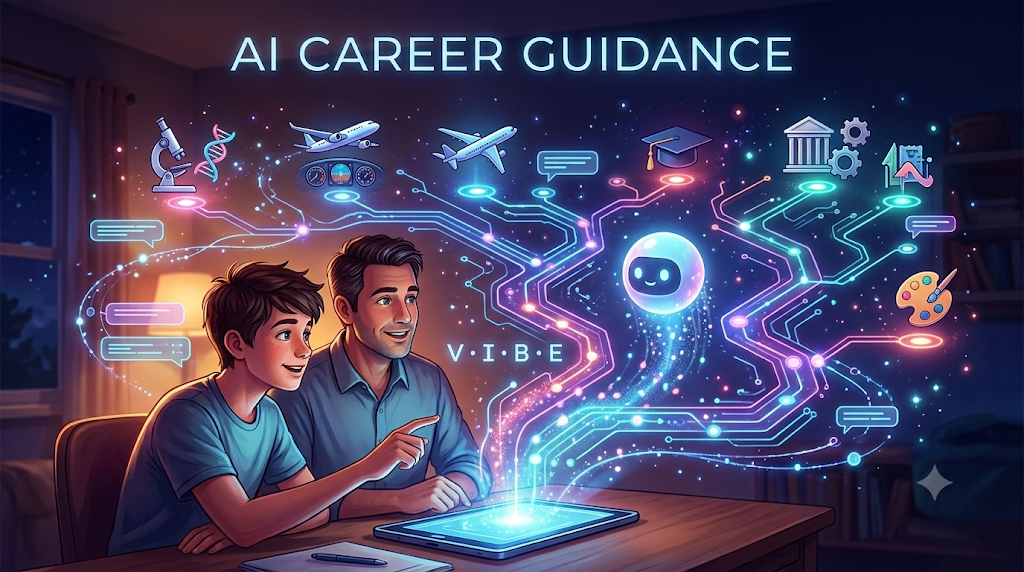
At BHKB, this is the thinking behind our VIBE framework—understanding a student's Values, Interests, Behaviour and Environment through conversation before exploring career possibilities.
Because the right career question isn't simply:
"Which career is successful?"
It is:
"Which possibilities make sense for this particular student—and why?"
And even that shouldn't be the end of the journey.
Career discovery should lead to understanding the career, evaluating its realities, identifying the right academic path and eventually preparing for the skills the student will need.
AI has transformational potential. But AI alone isn't the answer.
AI can access enormous amounts of information.
It can connect patterns.
It can explore possibilities.
It can personalise conversations.
But the quality of the outcome depends on how we design and guide the AI.
AI needs the right framework.
The right psychological understanding.
The right information.
The right questions.
And the right guardrails.
When these come together, AI can move from being a tool that simply answers career questions to a system that helps students discover, evaluate and prepare for possibilities they may never have known existed.
Because the future of career guidance may not be about choosing from the careers we already know.
It may be about discovering the careers that fit the person we are becoming.
The objective isn't to let AI make the decision. The objective is to make sure that the student doesn't make the decision with only a tiny fraction of the possibilities visible.