Part 2: If Aptitude Isn't the Whole Answer, Then What Is?
Aptitude is a valuable piece of career guidance, but it cannot identify the right path on its own. A holistic approach combines ability with interests, values, behaviour, experiences, aspirations and environment.

In Part 1, we looked at what aptitude tests can tell us—and, more importantly, what they cannot.
Aptitude can give us valuable information about a student's abilities. But career choice involves much more than ability. It involves understanding the person behind the score—their interests, values, behaviour, experiences, aspirations and the environment in which they are likely to thrive.
So, does that mean aptitude testing has no place in career guidance?
Not at all.
The real question is not whether aptitude tests are useful. The real question is how they should be used—and what needs to come alongside them to understand a student more completely.
Let's explore what a more holistic approach to career guidance could look like.
Aptitude tests can be useful.
They can help identify strengths.
They can highlight areas where a student may have natural ability.
They can provide additional information during career exploration.
They can help students understand themselves better.
They can become one input into a broader career guidance process.
The problem is not the existence of aptitude tests.
The problem is using them as the answer to a question they were never designed to answer completely.
Aptitude can be a useful piece of the puzzle.
But it is not the entire puzzle.
One ability can lead to many careers
This is another reason why directly connecting an aptitude score to a career can be misleading.
Consider a student with strong analytical ability.
Possible directions could include:
Data science
Engineering
Economics
Finance
Research
Analytics
Technology
Operations
Strategy
Consulting
Entrepreneurship
Which one is right?
The aptitude score alone cannot tell us.
We need to understand what the student actually enjoys.
Do they like working with people?
Do they enjoy technology?
Do they prefer research?
Do they want to build something?
Do they value independence?
Do they enjoy business?
Do they want a predictable career?
Do they want to work internationally?
Do they enjoy solving real-world problems?
These questions help convert ability into possibility.
Career choice should move from "matching" to "understanding"
For a long time, career guidance has often followed a relatively simple approach:
Take a test → get scores → match scores with careers.
It is easy to understand.
It is easy to communicate.
And it gives parents a sense of certainty.
But career choice is rarely that simple.
A more meaningful approach is:
Understand the person → understand their possibilities → explore careers → understand the reality of those careers → make an informed decision.
This changes the role of assessment.
Instead of asking:
"Which career does this score tell us to choose?"
we ask:
"What does this tell us about the student, and what should we explore further?"
That is a much more useful question.
So, what should a student look at before choosing a career?
Aptitude can be one part.
But students should also explore:
Interests
What naturally attracts your curiosity?
Values
What matters most to you?
Behaviour
How do you naturally think, respond and work?
Environment
Where do you feel most comfortable and productive?
Experiences
What situations have shaped your interests?
Aspirations
What kind of future do you imagine?
Skills
What can you do today, and what are you willing to learn?
Career reality
What does the actual profession look like beyond its title?
Future possibilities
How is the career evolving, and what opportunities could emerge?
When these dimensions are considered together, the picture becomes much richer.
What if career guidance began with understanding the person?
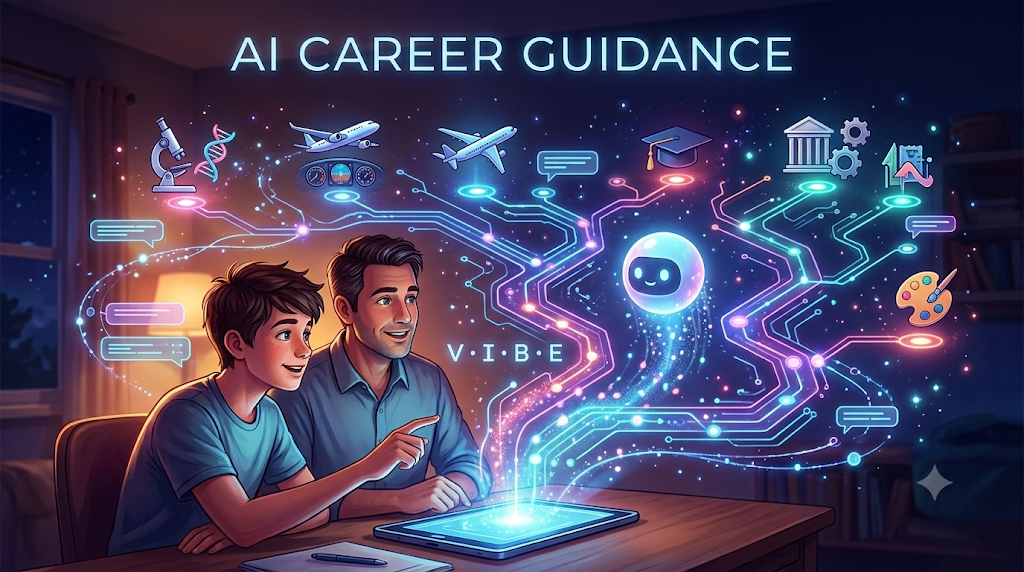
This is where technology can potentially bring a different dimension to career guidance.
Instead of asking a student to answer a fixed set of questions and immediately producing a career list, imagine beginning with a conversation.
Ask about experiences.
Ask follow-up questions.
Understand interests.
Explore values.
Understand behaviour.
Explore aspirations.
Understand the student's environment.
Look for patterns.
Then use that understanding to explore a much larger career universe.
This is where AI can become particularly interesting.
AI can have conversations at scale.
It can ask follow-up questions.
It can explore information.
It can connect patterns across large amounts of data.
And it can help students discover careers that may never have appeared on their original list.
But simply using AI isn't enough.
AI needs to be given the right framework to understand the human being it is talking to.
This is where VIBE comes in
At BHKB, we believe that career guidance should begin with understanding the student rather than immediately matching a score to a career.
Our VIBE framework looks at:
V — Values
What matters to you?
I — Interests
What naturally attracts your attention and curiosity?
B — Behaviour
How do you naturally think, respond and operate?
E — Environment
What kind of environment helps you thrive?
The purpose is not to say:
"This is your one perfect career."
Instead, it is to develop a deeper understanding of the student and use that understanding to explore careers that may align with who they are.
Aptitude can still be part of that larger picture.
But it should not be the entire picture.
Don't mistake a snapshot for the whole story
This brings us back to the fundamental question.
Can aptitude tests help in career exploration?
Yes.
Can they provide useful information?
Absolutely.
Can they tell us about certain abilities?
Yes.
But can aptitude alone tell us what career a student should choose?
That is a much bigger question.
A career is not simply a destination determined by today's ability.
It is a journey shaped by interests, values, behaviour, environment, experiences, aspirations, learning and growth.
A student is constantly evolving.
And the world of careers is evolving too.
So perhaps the better question isn't:
"What career am I capable of doing?"
It is:
"Who am I, what could I become, and what careers could bring those two together?"
Because ultimately, we are not defined only by the abilities we possess. We are also shaped by the possibilities we choose to pursue.
To let a test decide a career is to mistake a snapshot for the whole story.
And when we are talking about a young person's future, the whole story deserves to be explored.