Will AI Replace Software Engineers?
AI is reshaping software engineering by automating some tasks while creating new ways to build and solve problems. See which human skills will matter most as engineers learn to work effectively alongside AI.
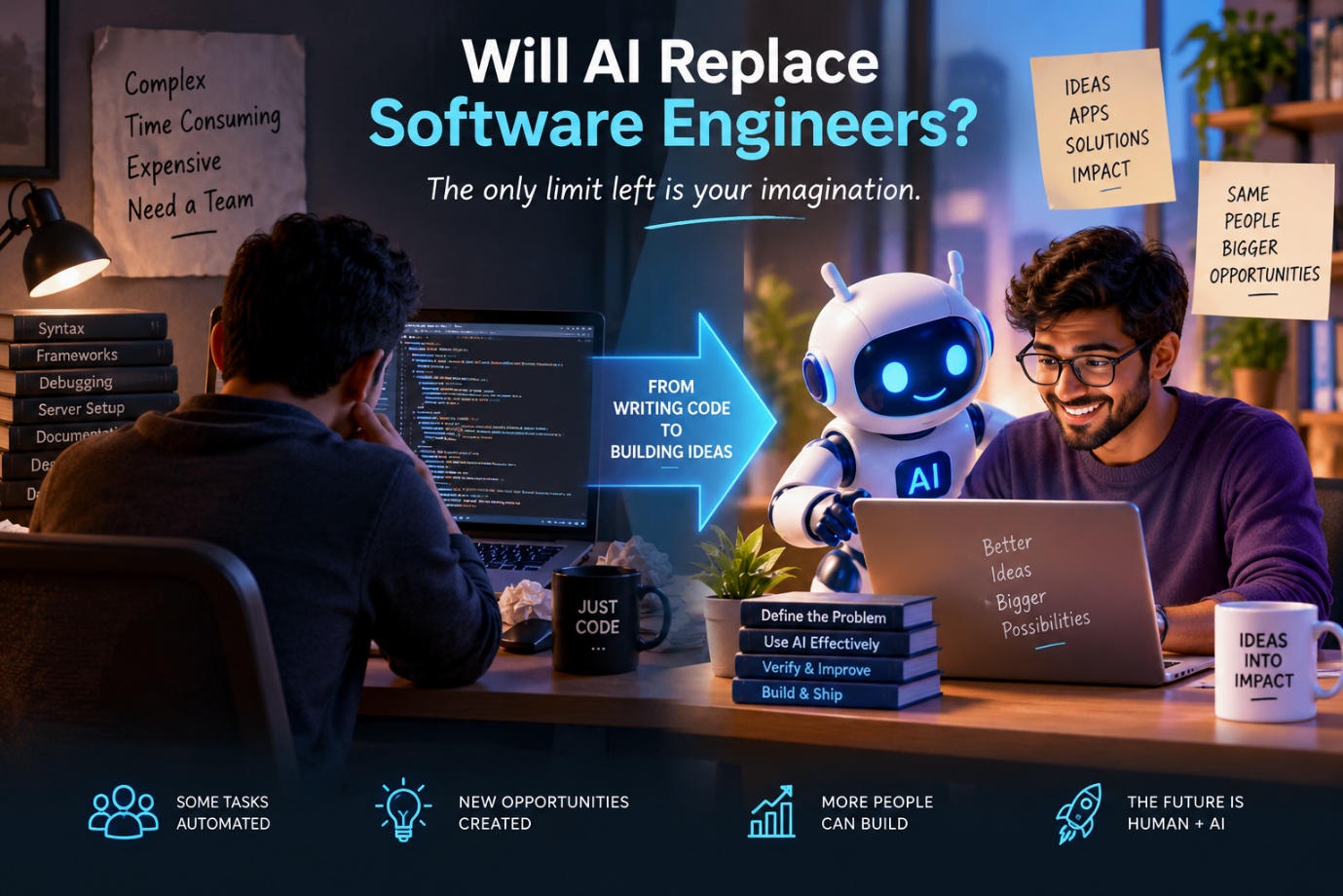
*The only limit left is your imagination.*
It's a fair question, and it deserves an honest answer: not entirely — but the role of the software engineer is changing. AI is already taking over some of the work that once required engineers to write code line by line, while creating new career opportunities for people who can define problems, communicate clearly, evaluate solutions, and work with AI effectively.
Open any news app and there's a decent chance you'll find another round of
tech layoffs affecting technology careers— thousands of people, many of them genuinely good at their jobs, let go within the same week. That's not exaggeration. It's just what's been happening, repeatedly, for the last couple of years.
Part of the reason is straight forward: many companies spent enormous sums building and buying AI tools and infrastructure. Investors and boards are now asking where the return is. One way for a company to improve its bottom line is to need fewer people to do the same work that AI can now help perform. So some real share of the layoffs in the news is, quite directly, AI being asked to pay for itself, at the cost of real people's jobs and stability.
That's a genuinely hard period for a lot of talented people, and it deserves to be treated as exactly that — not glossed over on the way to a more upbeat point.
But there's another side to this same story, one that gets a lot less attention: the very same technology reshaping career opportunities has also handed something else to individual people. It is the ability to build something entirely their own without needing a company, a team, or a large budget standing behind them first.
## How AI Is Changing Software Development
For years, you've probably had an idea for something you'd like to build.. Maybe it's an app that would make one part of your daily life easier. Maybe it's a tool for people in your line of work who deal with the same annoying problem you do. But then comes the familiar thought:
I don't know how to code. I can't afford to hire someone who does.
That sentence used to be the end of the story for almost everyone. It isn't anymore.
## How AI Makes Software Development More Accessible
Building software used to require one of two things: knowing how to code yourself, or paying someone who does — usually tens of thousands of dollars and months of waiting before you had anything real to show anyone.
That single requirement quietly decided who got to become a founder and who didn't, regardless of how good the idea was.
That wall has come down, fast.
Today, you can describe what you want to build in plain English — the way you'd explain it to a smart friend over coffee — and AI will build a working version of it. You look at what it made, tell it what to change, and it adjusts. Back and forth, until it matches the picture that's been in your head.
## How AI Is Changing the Role of Software Engineers
This is worth understanding, because it explains both halves of the story — the difficult part and the hopeful part.
For a long time, being a software engineer mostly meant typing precise, correct instructions for a computer to follow, line by line.
That was the core skill: turning an idea into exact code.
AI is now good enough at some of that work — the typing, the translating — that people don't need to do it manually anymore. That's one of the changes affecting software engineering careers.
But something important doesn't go away, for anyone — engineer or not.
Someone still has to clearly explain what should be built in the first place. Someone still has to carefully check whether what got built is actually right, safe, and doing what was intended.
Those two things — explaining clearly, and checking carefully — were always part of the job. They just used to be wrapped inside years of technical training. Now they're closer to the surface, and closer to something anyone willing to be careful and clear can learn to do.
That's what's opening up for you as a first-time builder looking to explore a career in technology, too. You're not doing a smaller, easier version of software engineering. Explain clearly, check carefully — that's the real core of it, the part that was never actually about typing.
## Can Nontechnical People Build Software With AI?
This isn't theory. People are already doing it.
Nomiki Petrolla's background is in politics, media, and community
Building — not engineering. When she decided to build a startup for women
founders, she faced the choice every non-technical person used to face:
find a technical co-founder, hire developers, or give up on doing it
herself.
She chose to build it herself — describing what she wanted, one
piece at a time, until the whole product existed.
Maor Shlomo had already spent seven years building a company the
traditional way, eventually growing it past a hundred employees. Then he
wanted to see what it looked like to build something without any of that
— no team, no office, just him and an idea.
In four months, working alone, he built a new company. Within a month of launching, it had earned $1.5 million. Six months later, a much larger company bought it for $80
million.
Neither of them started as a programmer. Both are examples of how not being
a programmer is no longer the obstacle it once was.
## What Skills Matter in an AI-Driven Software Career?
Having AI available to build for you doesn't remove the need for good habits — it just changes what the good habits look like.
**Know what you're building before you start building it.**
Spend ten minutes writing down, in your own words, what problem this solves and
who it's for. The clearer you are before you begin, the better AI can help you. A fuzzy idea gets you a fuzzy result, fast.
**Build in small steps, not one giant leap.**
Get one small piece working at a time. Look at it. Make sure it's actually what you wanted. Then move to the next piece.
Trying to build the whole thing in one go is how small mistakes hide inside big ones until they're much harder to fix.
**Don't trust the first version blindly.**
Treat whatever AI builds as a strong first draft, not a finished product. Use it. Click around in it. Try to break it.
If something feels off, it probably is. Say so, and let it be fixed before you build the next layer on top of it.
**Protect people's information if you're ever collecting any.**
The moment real people start putting their name, email, or anything personal into what you've built, it's worth having someone knowledgeable check it over before it goes further. This is the one habit on this list worth being genuinely careful about, not rushed.
**Stay curious as the tools keep changing.**
You don't need to master any one tool forever, and you don't need to become a technical expert. The tools themselves will look different again in six months, and the skills required for technology careers will continue to evolve.
The winning habit isn't mastery. It's willing to keep learning as things shift, instead of getting attached to how it worked previously.
## What AI Can't Replace in Software Development
Here's the thing worth sitting with: the hardest part of starting was never really the coding.
It was believing you were allowed to. That you had permission to build something, without a technical degree, without a co-founder, without a stack of savings to burn through first.
That possibility exists now, in a way it genuinely didn't a few years ago, even for people considering a career in software development.
The idea you've been carrying around — the one you've mentioned to maybe one or two people, if that — doesn't need anyone else's approval to become real anymore.
##The Answer Isn't Just About Replacement
So yes — will AI replace software engineers?
For some roles, in some companies, that disruption is already real, and it's fair to feel however you feel about that.
But for anyone who's ever had an idea and no way to build it, the same technology just quietly opened a door that used to be locked.
The only real limit left on the other side of it is your imagination.