How to break free from India's "big 3" career pressure
Why do doctor, engineer and CA still dominate India's idea of a successful career? Explore how self-awareness and wider career exposure can help students choose a path that genuinely fits.

The Big 4.
Big Ben.
The Eiffel Tower.
The Colosseum.
The Statue of Liberty.
I'm sure we've all heard of them.
But the Big 3?
We know them.
We just don't call them that.
"Wow! Her daughter is an engineer from IIT!"
"Oh, look at his son. He cleared NEET in his first attempt."
"A CA? Your life is set!"
Got it now?
Doctor. Engineer. CA.
India's unofficial Big 3 career choices.
And somehow, these three careers have managed to occupy a disproportionate amount of space in our definition of success.
But how often do we hear:
"She's going to be a writer. That's amazing!"
"He's studying fashion design. That's so cool!"
"She wants to become a wildlife researcher."
"He's building his own company."
"She's studying animation."
"He's interested in psychology."
"She wants to work in sustainable energy."
These careers exist. They are real. People build successful lives through them.
So why don't they receive the same excitement?
Why are we so obsessed with the "safe" career?
For generations, Indian families have understandably valued stability.
A good education was seen as the route to a secure job.
A secure job meant financial stability.
And financial stability meant a good life.
There is nothing wrong with wanting security for your child.
The problem begins when security becomes the only parameter used to choose a career.
A career can be considered "safe" simply because it is familiar.
Everyone knows what a doctor does.
Everyone understands what an engineer does.
Everyone knows what a CA does.
But what about careers that are newer, specialised or less familiar?
UX researcher.
Data scientist.
Sports psychologist.
Product designer.
Climate scientist.
Game designer.
Biomedical researcher.
Food technologist.
Film editor.
Cybersecurity specialist.
Entrepreneur.
Urban planner.
Environmental consultant.
The list goes on.
The world of work has expanded dramatically.
But our mental list of "acceptable" careers often hasn't expanded at the same speed.
We tell children they can choose anything.
But do they really feel that way?
Ask a student:
"What do you want to become?"
You might hear:
"Doctor."
"Engineer."
"CA."
And sometimes, if you ask a little further:
"Why?"
The answer isn't necessarily:
"Because I love this kind of work."
It could be:
"My parents think it's a good career."
"Everyone says there are lots of opportunities."
"My friends are preparing for it."
"I've been studying for it since Class 9."
"It pays well."
"It's a respected profession."
"I'm not sure what else I can do."
That last answer is particularly important.
Because sometimes the problem isn't that a student has chosen the wrong career.
The problem is that they haven't had the opportunity to discover enough alternatives.
Familiar doesn't always mean suitable
Imagine you have three restaurants in your neighbourhood.
You eat at one because you've eaten there before.
You eat at the second because your family likes it.
And you eat at the third because your friends recommended it.
You might have a perfectly good meal.
But that doesn't mean those were the only three restaurants that could have suited your taste.
Career choices can work in much the same way.
We often choose from the careers we know.
And we know the careers our environment has exposed us to.
Parents influence us.
Friends influence us.
Teachers influence us.
Social media influences us.
Relatives influence us.
Society influences us.
And gradually, a student's career universe can become much smaller than the actual career universe available to them.
Then there is the "safe" career trap
"Take Science. You can decide later."
"Engineering gives you many options."
"Do CA. You can always do something else afterwards."
"Become a doctor. You'll never have to worry about your future."
We've all heard versions of these statements.
They are usually said with good intentions.
But there is an important question we should ask:
Safe for whom?
A career may be financially attractive or socially respected, but that doesn't automatically make it suitable for every student.
A career that is perfect for one student may be deeply frustrating for another.
One student may love solving complex mathematical problems.
Another may come alive while designing something.
Another may enjoy understanding people.
Another may want to work outdoors.
Another may be fascinated by how businesses work.
Another may spend hours creating stories, videos or music.
Another may love taking things apart and figuring out how they work.
These differences matter.
Because career fit matters.
So what should students actually look for?
The answer isn't to reject conventional careers.
Being a doctor, engineer or CA can absolutely be the right choice for a student.
The real question is:
Is it the right choice for this student?
That requires looking beyond marks and popularity.
Here are a few places to start.
1. Know what genuinely interests you
This doesn't mean choosing a career because you like something occasionally.
Ask yourself:
What do I naturally spend time exploring?
What topics make me curious enough to keep going?
What kind of problems do I enjoy solving?
What activities make me lose track of time?
What do I keep coming back to even when nobody asks me to?
An interest that survives repeated exposure is often more meaningful than a temporary fascination.
But remember—interest alone isn't enough.
You also need to understand your abilities, preferences and the realities of the career.
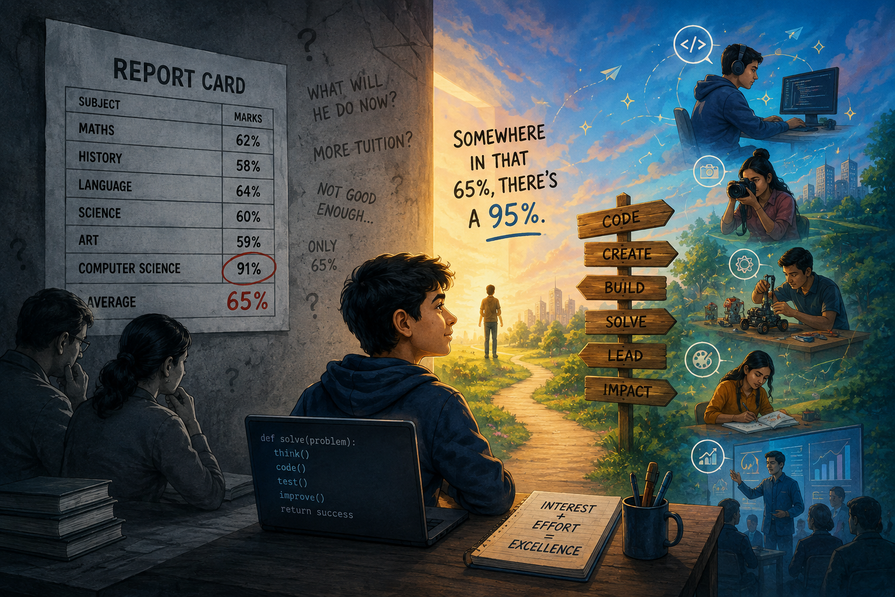
2. Understand your strengths—not just your marks
Marks tell us something.
They don't tell us everything.
A student's strengths can appear in many forms.
Analytical thinking, Communication, Creativity, Empathy, Leadership, Observation, Problem-solving.
Some of these strengths are visible in a report card.
Many aren't.
3. Don't stop at the first career you discover
Suppose you enjoy Biology.
Does that automatically mean medicine?
Not necessarily.
Biology can lead to medicine, but also to biotechnology, genetics, microbiology, neuroscience, biomedical research, environmental science, food science, bioinformatics, healthcare technology and many other areas.
Suppose you love computers.
Does that automatically mean software engineering?
Again, not necessarily.
There are careers across cybersecurity, AI, data, product development, UX, computational research, game development and many other fields.
One interest can open many doors.
The challenge is discovering those doors.
4. Explore the career—not just the career title
A career title can sound exciting.
The actual work may be very different.
"Doctor" sounds impressive.
But what does a typical working day look like?
What kind of pressure does the profession involve?
What qualifications are required?
How long does the preparation take?
What specialisations exist?
What are the working environments?
What does early-career life look like?
What are the growth opportunities?
Similarly, "designer" sounds interesting—but what kind of designer?
"Engineer" is incredibly broad.
"Lawyer" is incredibly broad.
"Researcher" is incredibly broad.
Before choosing a career, understand what the career actually looks like in the real world.
Don't choose a title. Understand the life behind the title.
5. Talk to people who actually do the work
This is one of the most valuable steps.
Talk to people working in careers you are considering.
Ask them:
What does your typical day look like?
What do you enjoy?
What do you find difficult?
What surprised you after entering the profession?
What skills matter most?
What would you do differently if you were starting again?
Google can give you information.
A person working in that profession can give you context.
And context matters.
At the same time, remember that one person's experience is still one person's experience.
Don't make a career decision based on a single conversation.
Talk to more than one person and look for patterns.
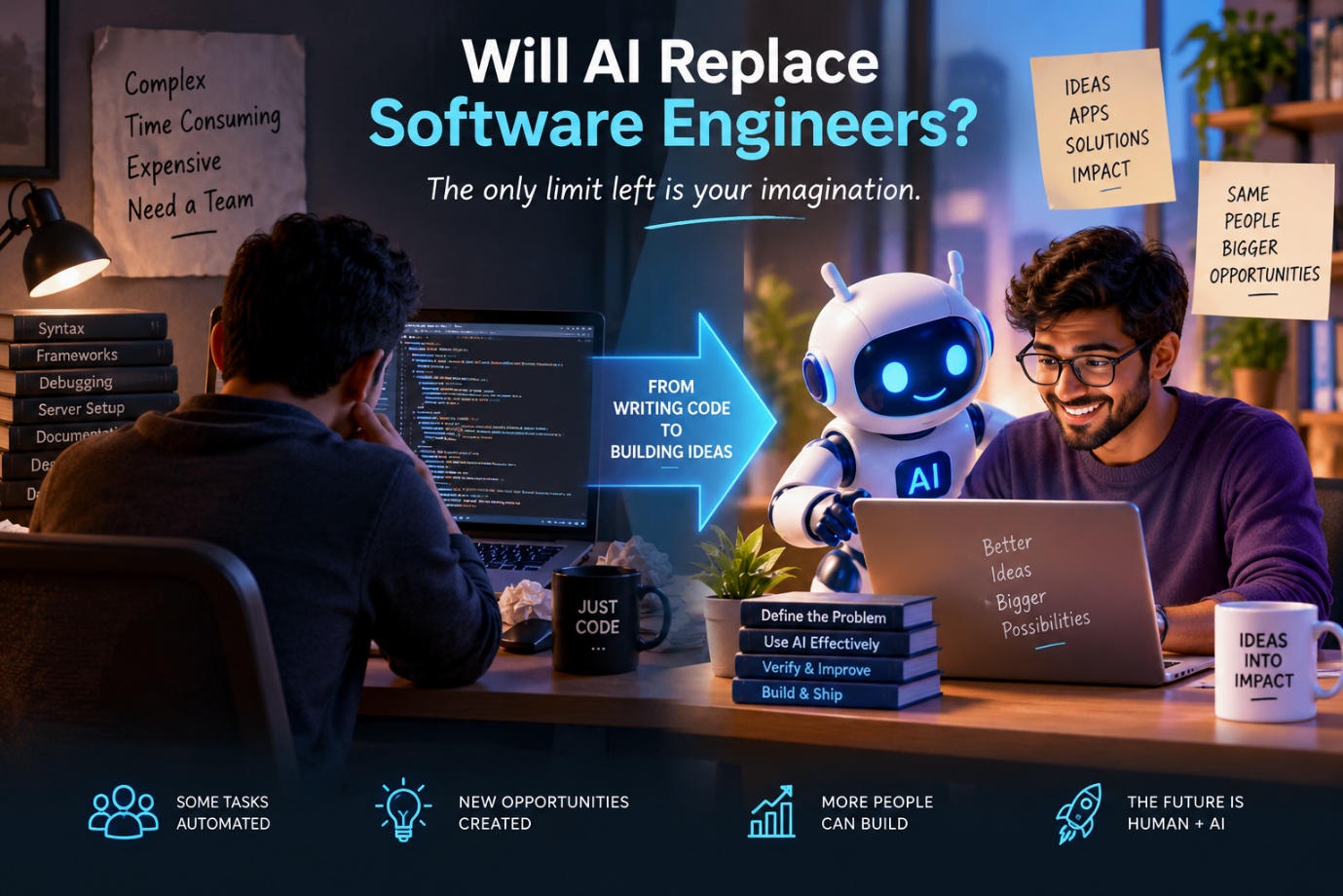
6. Look beyond what is popular today
The world of work doesn't stand still.
Technology changes industries.
New industries create new roles.
Existing roles evolve.
Some jobs become less relevant while entirely new specialisations emerge.
This means today's popular career list shouldn't automatically become tomorrow's career list.
Students should ask:
What is changing?
What skills are becoming valuable?
Which industries are growing?
What new roles are emerging?
What careers are likely to evolve with technology rather than simply be replaced by it?
The goal isn't to predict the future perfectly.
It is to become curious about it.
7. Don't let peer pressure become career guidance
Your best friend wants to become an engineer.
So you think you should become one too.
Everyone in your coaching class is preparing for NEET.
So you continue preparing.
Your cousin got into a prestigious college.
Now your family wants you to follow the same route.
This is where comparison becomes dangerous.
Your friend's strengths are not necessarily your strengths.
Their interests are not necessarily your interests.
Their circumstances are not your circumstances.
Their definition of success doesn't have to become yours.
A career isn't a group project.
You have to live it every day.
Parents have a role too
Breaking free from the Big 3 doesn't mean blaming parents.
Most parents aren't trying to restrict their children.
They are trying to protect them.
They want financial security.
They want stability.
They want their child to have opportunities.
And when faced with uncertainty, familiar careers can feel easier to trust.
The challenge is to replace:
"Which career is safest?"
with:
"Which career could be a good fit for my child—and what evidence do we have?"
Instead of asking only:
"What does your child want to become?"
Parents could also ask:
"What kind of work brings out the best in your child?"
"What problems does your child enjoy solving?"
"What environment helps them thrive?"
"What are they naturally curious about?"
"What careers have we not explored yet?"
Those questions can open a very different conversation.
The goal isn't to escape the Big 3
This is important.
There is nothing wrong with becoming a doctor.
Nothing wrong with becoming an engineer.
Nothing wrong with becoming a CA.
If a student genuinely wants one of these careers and their interests, strengths and circumstances align with it, it can be a perfectly meaningful choice.
The problem is not the Big 3.
The problem is when the Big 3 become the only 3 careers we seriously consider.
The goal isn't to run away from conventional careers.
The goal is to make sure that students have enough visibility to make an informed choice.
So, how do you choose?
Start with yourself.
Know what interests you.
Understand your strengths.
Explore beyond familiar career names.
Understand what the actual work looks like.
Talk to people doing that work.
Research the education and preparation required.
Consider your preferred environment and lifestyle.
Look at how the field is changing.
And most importantly:
Keep your options open long enough to discover them properly.
Because choosing a career shouldn't be a popularity contest.
It shouldn't be a comparison with your neighbour's child.
It shouldn't be an attempt to fulfil someone else's unfinished dream.
And it certainly shouldn't be a decision made simply because:
"Everyone is doing it."
There are hundreds of career paths.
Thousands of roles.
Multiple ways to reach them.
And many careers that a student may never have heard of yet.
The real challenge isn't choosing between Doctor, Engineer and CA.
The real challenge is discovering what else is out there—and what might fit you.
One last thought
There are plenty of paths.
Choosing a different one isn't necessarily a risk.
Sometimes, the biggest risk is choosing a path without first asking whether it is yours.
And sometimes, the career that sounds least impressive at a family gathering can turn out to be the one that makes the most sense for the person living it.