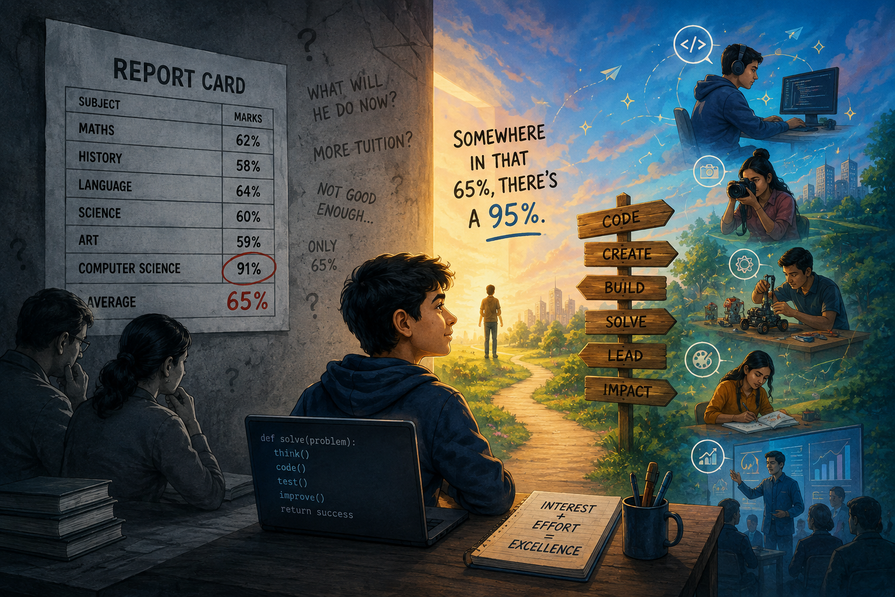
My Child Is in Grade 10 and Has No Idea What They Want to Do. Now What?
Not knowing what to become in Grade 10 is a normal part of exploration, not a warning sign. Discover practical ways parents can reduce pressure and help their child build clarity through curiosity and experience.

It happens at almost every family gathering. An uncle, an aunt, a family friend leans toward your Grade 10 child and asks, kindly, “So what do you want to become?”
Your child shrugs. Maybe mumbles something vague. Maybe just goes quiet.
And you feel it — that small jolt of panic. Everyone else’s kid seems to have an answer. Doctor. Engineer. Something. Yours doesn’t. Suddenly you’re doing the math in your head: two years to board exams, then a stream to pick, then it all supposedly locks into place. And your child is standing there with nothing.
Here’s what’s worth knowing before the panic takes over: not having an answer at fifteen isn’t a warning sign. It’s closer to the opposite.
Is It Normal for a Grade 10 Student to Not Know Their Career Path?
People who study how teenagers form their identity talk about two stages that happen in order: exploration first, then commitment. Exploration means trying on different possibilities and seeing what fits, without locking anything in yet. Commitment — actually settling into a direction — is only supposed to happen after that. Often it doesn’t happen until college or later, not at fifteen.
In fact, this exploring stage is exactly what the teenage years are for. A fifteen-year-old who confidently names a career plan hasn’t necessarily grown up more than one who shrugs. They may just be further along in exploring — or they may have skipped that step entirely. And skipping it isn’t the win it looks like.
Why Indian Parents Panic When Their Child Doesn’t Know What They Want to Do
It helps to name what’s really driving the panic, because it’s rarely about the child at all. It’s the board-exam clock, which makes two years feel like two months. It’s the cousin or neighbour’s kid who “already knows,” which makes your child’s shrug feel like falling behind. It’s the short list of careers — engineering, medicine, CA — that still quietly counts as “safe” at family gatherings, which makes anything else feel risky.
None of that pressure is really about whether your child is ready. It’s about everyone else’s timeline drowning out the question of what’s actually true for your child.
How to Spot Your Child’s Real Interests Before Choosing a Stream
Here’s the one thing a parent can actively do that isn’t just “wait it out”: watch for real interest. A real interest usually shows up as a pattern, not a single moment. It’s something your child is good at, enjoys, and keeps coming back to on their own — not just one or two of those three. Notice what they do without being asked. Notice what makes them lose track of time. Notice what they explain to someone else without being prompted. That combination tells you far more than any single grade or offhand comment.
This isn’t just a nice thing to notice. It’s the raw material for two big decisions coming up for your child. The first is stream selection — Science, Commerce, or Arts. That choice stops being a guess about “which one keeps the most doors open” the moment it’s grounded in something real about your child.
The stream is also just a stepping stone to the bigger decision after it: what they study after Class 12. If the stream is picked on autopilot, with no real interest behind it, it usually doesn’t solve the “I don’t know” problem. It just pushes the same question two years down the road — at higher stakes, with less room to change course. A student who’s good at three subjects but never noticed which one they’re actually drawn to often ends up picking the “safe” one. That’s exactly how a real strength stays hidden behind an average score instead of shaping the decision.
What Is Identity Foreclosure, and Why Rushing a Career Decision Backfires
There’s a name for what happens when a teenager locks in a direction too early, usually under pressure: identity foreclosure. It means closing the door on exploration before it really opened — often because handing over an answer feels safer than sitting with “I don’t know.” Foreclosure is directly linked to strong parental pressure: the more a teenager feels pushed toward a set answer, the more likely they are to adopt one that isn’t really theirs.
This matters because the instinct at that family gathering — to jump in and soften the silence with “well, they’re good at maths, maybe engineering” — comes from a loving place. But it can quietly teach a child that the goal is having an answer ready, not finding the right one.
Common Mistakes Parents Make When Guiding a Grade 10 Child’s Career Decision
Copying what other families are doing. A neighbour’s son joins a coaching class, a relative’s daughter picks a stream and it “works out” — and suddenly that choice feels like the safe, proven one. But that path was shaped by a different child’s interests and circumstances, not your child’s. Copying it doesn’t lower the risk. It just replaces your child’s real path with someone else’s answer.
This is why it’s worth resisting the pull to decide anything before Class 10 is over. Not because more time magically brings clarity, but because a decision made now, based on what a few other families happened to choose this year, is a decision made on borrowed information. Let the board exams finish. Let the results and the conversations that follow give you real, first-hand information about your own child. Only then start narrowing things down — based on what you’ve actually observed, not what looked safe in someone else’s home.
Treating a single test as a verdict. A one-time aptitude test can be useful, but it was never built to capture the whole picture — values, real interests, how your child handles pressure, what environment brings out their best. Treating its result as the final word closes off exploration just as fast as a relative’s comment does.
Letting one bad grade close a door permanently. A hard term in a subject often gets read as “I’m just not capable in this,” and the subject gets quietly crossed off — sometimes based on one difficult stretch, not any real reflection. A low grade is one data point. It isn’t a verdict, and it’s worth a second look before you and your child rule something out together.
How Academic Pressure Affects Indian Students’ Mental Health
While all this uncertainty plays out, there’s a second, quieter risk worth taking seriously: the years around board exams are genuinely hard on Indian students’ health. It’s easy for that to get lost under the bigger question of “what will they do.”
The numbers are worth sitting with. A study of Indian high school students, published in the International Journal of Psychology and Behavioral Sciences, found that about two-thirds felt real pressure from parents to excel academically, and roughly the same share felt stress they linked directly to academic pressure. More than four in five had some level of exam-related anxiety. About a third scored high enough on a standard mental-health screening to be considered at risk.
This isn’t a rare experience. For a very large share of students, it’s the norm.
Here’s the encouraging part: the fix doesn’t have to be dramatic or time-consuming. Regular movement — even short, informal bursts, not a structured fitness routine — is one of the simplest ways to protect a stressed teenager’s wellbeing. It doesn’t need to eat into study time in any real way.
Build something small and non-negotiable into the week — a short walk, ten minutes of a sport they enjoy, anything that gets them moving and away from books for a while. It doesn’t need to be long to make a difference. And treating it as optional is usually how it quietly disappears during exam season — exactly when it’s needed most.
What Parents Can Do to Help a Grade 10 Child Find Direction
Don’t push for an answer. Don’t panic. Here are a few things that genuinely help, starting now:
Let “I don’t know yet” be a complete, acceptable answer — at home, not just in theory. The biggest thing you control is whether your child feels safe saying that sentence to you. If every conversation about the future carries a hint of “you should have some idea by now,” they’ll learn to fake certainty instead of actually developing it.
Give them real, varied exposure — not just career fair pamphlets. A half-day shadowing a family friend at work. A conversation with someone in a field they’ve mentioned even once. A short course in something unfamiliar. Real exposure to what different work is actually like does more for exploration than any list of “top careers after Class 10.”
Separate the conversation about grades from the conversation about direction. These are two different topics that tend to collapse into one anxious conversation. A hard term in a subject is worth addressing on its own. It doesn’t need to also settle a much bigger question about who your child is.
If you want to help the exploration along, rather than just waiting it out — a structured conversation built around a teenager’s real interests and stories, rather than a one-time test with a score at the end, can genuinely speed things up without cutting corners. That’s different from demanding an answer. It’s giving exploration a clearer shape.
The Bottom Line for Parents of a Grade 10 Child
Fifteen is not late. It’s not even close. This is exactly the age when not-knowing is supposed to happen. The years ahead — choosing a stream, making the first real decisions — are exactly when exploration is meant to still be open, not already closed.
The most useful thing you can offer your child right now isn’t an answer. It’s room, a watchful eye for what genuinely lights them up, and the sense that “I don’t know yet” is something they can say to you without flinching.
This is part of BHKB’s ongoing series for parents navigating their child’s path to a career. If you’d like a structured way to help your child explore who they are — not a test, a real conversation — VIBE is built for exactly that stage. Explore it at BHKB.ai.